Banarasi Saree: Six Yards of Hand-Crafted Opulence
By Smita Ray
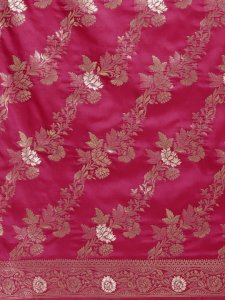
Banarasi weave bears the distinction of being the companion of an Indian bride, just as she embarks on her marital life. The intricate handwork embroideries of gold and silver zaris speak of the meticulous craftsmanship of the artisans. Traditionally valued for their texture, motif and uniqueness, this sartorial elegance epitomizes social status. Worldwide, the incredible style and pattern used in Banarsi Saree is known as Kin Khabs (kin means golden and khab means dream). Brocade is a specialty of Banarasi fabric. The term brocade is derived from the Latin word ‘brocca’ meaning to prick. It is a weave where patterns are created by inserting the Zari thread between the warp at specified intervals. The pure form of Zari was actually a thread drawn of pure gold which was truly something to dream about. Other forms are Bafta, comprising mostly of closed woven color silks, with only selected parts of the design in gold or silver thread. Another type is light brocades of silk, muslins with little metallic thread, or with golden borders and end pieces sewn on them. From draping the royalty to being a prized possession among commoners, this elegant and luxurious weave has a long and fascinating story to tell.
Journey through time
Banarasi sarees originated from the Varanasi/ Banaras or Kashi, a historic city in North India known for its social, economic, and religious significance. The heritage of hand-woven fabrics of Benaras dates back to the Rig Vedas. One finds its mention in the Hindu epics and stories related to Gautam Buddha during his days as Prince Siddhartha. Silk weavers migrated from Gujarat during the famine of 1603, and probably silk brocade weaving started in Banaras in the 17th century and developed in excellence during the 18th and 19th centuries. The earliest mention of the brocade and Zari textiles of Banaras is found in the 19th century. With the advent of Mughal rule, Banarasi sarees adopted a change in pattern. In order to cater to the religious bindings of Islam, the traditional silk was replaced by a mixture of silk and cotton. At that time, Panara craftsmen developed unique and intricate silk fabrics using golden and silver zari yarns. The elegance of Banarasi sarees caught the attention of Westerners as well. Travellers like Ralph Fitch, an Englishman who visited Varanasi in 1583, described the fabric as “fine as the filmy webs and spider weavers.” French traveller, Tavernier wrote about the affluence of the Banaras silk and brocade industry in 1665 AD. The Banarasi textiles were exported all over the world during the 17th century AD. Banarasi textile was threatened with the introduction of power loom and prevention of Banarasi export by the East India Company. The art continued to survive due to the weavers’ persistence.
The motifs
During the Mughal rule, geometric and floral motifs became prevalent. Holy scriptures were woven for the Hindu rulers. Interestingly, change in the design trend was noticed as India became a center for Western colonizers. Persian, English and Chinese patterns were frequently adopted. A characteristic motif of the Moghul period, commonly called as the Shikargah is seen on the Banaras Saree. Today, a variety of designs ranging from nature to geometric patterns to human figures can be seen. Based on the design pattern, various names are given such as tara buti (star), ashrafi buti (small dots), taj buti (crown), tota buti (parrot), hathi buti (elephant), etc. Banarasi weave stands as a witness to the artistic splendor of India over the ages. To cater to the nobility, zari works was done with original gold and silver. In due course, these were replaced by golden and silver color threads. The varieties of styles on the borders are unique as well. Special emphasis is given at pallu with decorative dense borders. Their special characteristics are intertwining floral and foliate motifs, kalga and bel, a string of upright leaves called jhallar at the outer edge of border is a characteristic of these saris. Other features are gold work, compact weaving, figures with small details, metallic visual effects, pallus, jal (a net like pattern), and meena work.
The fabric
The main fabrics used for Banarasi sarees are organza (Kora), Georgette, Shatir and pure silk (Katan). Organza is a thin and lightweight fabric, with exquisite Zari work and shimmers with shades of silver and gold. There is a unique border in Kora sarees irrespective of the variety of intricate designs on the base. Georgette is one of the lightest fabrics with beautiful floral and foliate designs on the base or borders. This fabric is made with highly twisted yarns finely woven in both warp and weft. The Shatir fabric is comparatively lighter and more simplistic hence more affordable. Simpler and contemporary designs make them suitable for everyday wear. Katan sarees have extravagant twisting of the pure silk threads.
The many varieties of Banarasi silk Organza, Satin borders, Jangla, Brocades, Tanchoi, cutwork, and Resham butidar are the different types based on fabric material and design pattern. The weaver spins the yarn in back-and-forth technique to weave the Brocade. Brocades in Banarasi sarees are either kadhua or fekuan Banarasi brocade. Kadhua is discontinuous brocade (extract weft in the back of this fabric), while fekuan is a continuous brocade. Banarasi sarees require 5600 threads and is about 45 inches broad with a base that is at least 24 to 26 inches long. Tissue Banarasi are the zari brocade; the mixture of zari and silk renders the characteristic sheen. Butidar sarees are blue silk brocaded with the thread of silk silver and golden. Cutwork saree has a plane texture. Tanchoi Banarasi are woven of colorful weft silk Yarn. Jangla saree has colorful silk thread and showcase nature inspired motifs. Shatir cloth is used for a modern Banarasi saree. Katan is a plain fabric that has woven natural silk thread to make a natural silk saree. In olden days, the yarns used were purchased from Bangalore, Kashmir and Malda and the Zari from Surat. Silk exported from China was also used. Today most of the silk fabric is obtained from different parts of South India. A variety of colors ranging from pastels to darker tones are seen. Different names are given as per the color: Nilambari (blue), Raktambari (red), Pitambari (yellow) and modern ones such as Gulabi (pink), Taberji (pink-red), piyazi (light pink), moongia (olive green), Badami (light buff), etc. ‘Rangkat’ is a combination of ten different colours – an epitome of majestic splendour.
The weaving process
The weavers in Banaras are primarily Muslims (Ansaris) known as Karigaars, meaning artists. There are also a few Hindu weavers involved in brocade production. Karkhanas are the weaving centres and are spread all over the modern city of Varanasi. Traditionally, the weaving was done with Naksha drawlooms, which was introduced in India during 990 AD. Later the heddle system was introduced in the 16th century by Khwaja Abdul Samad Kashmiri, who came to Banaras during Akbar’s reign. This type is found till date. The jacquard loom was introduced in Benaras during the 1930s. The single loom weaver is known as the Bunkaar. About 15 to 30 days are required to finish the weaving of the Banarasi saree and 3 weavers synchronize to complete the process. One weaves the saree base, the second handles the revolving ring that is making the bundles, and the third one assists in border designing. Sometimes the production time could be six months or longer, if the designs are complicated, unique and intricate. Authentic handloom Banarasi has floats between the grids of warps and wefts on the reverse side and a patch of plain silk, about 6 to 8 inches long, on the pallu. During 1500 BC to 500 BC, the Vedic text mentions weavers as Tantuvayas, while brocades were known as “Hirayana”. The two traditional weaving centers in Varanasi are at Madanpura and Alaipura, each having their own techniques, fabric textile and design. Other areas around Varanasi district like NatiImli, Lallapura, Chittanpura, Ramnagar, Dulahipur, Pilikothi, Cholhapur and Dharsauna also produce Banarasi silk sarees and fabrics. The major steps comprise of procuring raw materials, twisting of the silk yarn, preparing the threads for reeling, winding on the loom frame, opening the threads for wrap, dyeing, design making and weaving. Post-weaving procedures include packing, buti-cutting and finally polishing.
Need for conservation of traditional culture
In the age of technology driven modernization, the handloom art faces the threat of extinction in the competitive market. The painstaking craftsmanship results in increased cost and manufacturing time. Artisans fall victim to market demand and are often drastically low paid. The original weavers have mostly acquired the skill from their ancestors. Once there was a thriving population of 6 to 8 lakhs weavers in Varanasi which has now reduced to merely 50000. Lack of infrastructure is forcing present generation artisans to diverge from the loom industry. Owing to the awareness generation by activists, attempts are being made to conserve this unique craftsmanship. The GI tag was granted to “Banaras Brocade and Sarees” on 4th September 2009 and was registered under Application No. 99 in classes 23, 24, 25 & 26. The geographical region wherein the GI was granted included Benaras in the areas of Lohta, Bazardiha, Sarai Mohana, Lallapura, Saraiya, Bagwanala and Badi Bazar, and comprises of an area much larger incorporating the five districts of Uttar Pradesh, namely Varanasi (Benaras), Chandaulim Bhadohi, Mirzapur and Azamgarh. This not only economically benefits the weavers but also helps in authentic identification. The Ministry of Textiles then established multiple initiatives looking into welfare of the handloom weaver. Banarasi Sarees and Brocades are integral and ancient part of our Indian Cultural heritage and, thus, preservation of this legacy resonates with the pride of the nation.
Bio:
Dr. Smita Ray works as Assistant Professor in WBES. Posted in Bethune College, Kolkata, her area of specialization is Botany and Biotechnology. She has keen interest in the cultural heritage and the traditional assets of India which she likes to explore at her own pace.
***
For more stories, read Café Dissensus Everyday, the blog of Café Dissensus Magazine.


 Café Dissensus
