The Warp and the Weft and a Visit to Pulugurtha
By Nishi Pulugurtha
I believe almost all Indian women have saree stories – stories, that like the sarees that form the tapestry of weaving in India, are myriad and stored up in naphthalene balls, in fragrant saree packets available these days, in wooden cupboards, in steel almirahs, in closets, in trunk and boxes, that are worn and washed and starched and pressed, that are laid out in the warm winter sun, shared with sisters, aunts and friends, not shared too and the list could go on.
My saree story began years go. There is no way I can pinpoint a specific time. I was told that I had a runny nose always. The joke in the Pulugurtha household was that I sneezed as I came into the world. I would rub my nose against any cloth that came in my way – the curtains, Appagaru’s pyjama and Amma’s saree. Was that how the fabric came to be part of my being? I am not sure. One thing I am sure and clearly remember is Amma draping beautiful six yards of fabric and me gazing in awe at it. She always said that all her sarees would be mine one day. By the way, I was a cy baby and always cried out loud whenever Amma bought a saree. I wanted one too.
Three and half years younger to me, my sister was my friend, playmate and companion and ally in all the things I planned up. She followed me like a shadow (at times that irritated me), accepted all I set out to do, no questions asked and a faithful accomplice too. On school holidays the two of us would be at home and among all the kinds of games that kept us busy there was one kind of play that we liked was the draping of Amma’s sarees. Each of us would pick one saree of our liking, drape it, play for a while and then carefully fold it back the way it was. We had to make sure that it was kept back the way it had been kept. Amma did find that out but then she had no cause for complaint as they were in the perfect order.
The first time I wore a saree and travelled draped in it was the Class 10 Farewell Party at school. Several of us were draped in the six yards that day, I recall. Thus began my saree story. I recall going saree shopping with Amma. She had an uncanny eye to spot, select and pick the best. Years later, now, I have that trait. I can enter into a shop, look around and ask the person at the counter to show me one that was stacked with myriad others. Blame it on the genes, I can almost hear my father saying.
Handloom sarees are woven painstakingly; many of them take days and months to weave; yarn is expensive and all of this makes the finished saree expensive. Each state of India has its own handloom weaves and styles. Weavers across India struggle to make ends meet and survive in a world where the power loom ones are much cheaper and easily available. They look so similar to the handloom ones that only a keen eye can notice the differences. Several of them are now using social media to display and to reach out to potential customers.
The state of Andhra Pradesh was the first Indian state to be carved on the basis of language and came into existence in 1956. Three regions – Telangana, Rayalaseema and coastal Andhra – were brought together to create Andhra Pradesh. In June 2014, the state was bifurcated into Andhra Pradesh and Telangana. Uppada, Chirala, Mangalgiri, Venkatgiri, Dharmavarm, Gadwal, Pochampalli, Narayanpet are place names from Andhra Pradesh and Telangana, where the saree with the eponymous names is woven. The story of the warp and the weft is also a story of a textile yatra, a journey across these places and the wonderful handwoven textiles they are known for.
I have had in mind such a travel idea for years now. While I have not been able to undertake one physically, I have done it vicariously via reading and seeing photographs. A sudden invitation from an aunt in Kakinada for a family function made me decide to make the journey to the place where I was born. I had been planning to travel to Kakinada for several years now but couldn’t make it for various reasons. Kakinada would feature in a saree story because of the village of Uppada that is close by. This place is famous for the Uppada sarees that are extremely popular these days; the place has a very nice beach too.
However, it is not about the Uppada saree that I am going to write about but about a much less known variety. My piece is about the village of Pulugurtha. The village that I trace my surname, family name to. In Telugu, what is referred to as the surname is called inti peru. The word inti means ‘home’ and the word peru is ‘name’ and each inti peru is linked to a village, as it traces its name to a village. My father often spoke of the village of Pulugurtha and of its location. Our inti peru comes from this place. My father’s family, a few generations of it, lived in the village of Arthamuru that is about 6 kilometres away from Pulugurtha. His father moved out from the village to Jeypore where my father was born and spent his childhood. It was with this in mind that I decided to visit these two villages on my Kakinada trip.
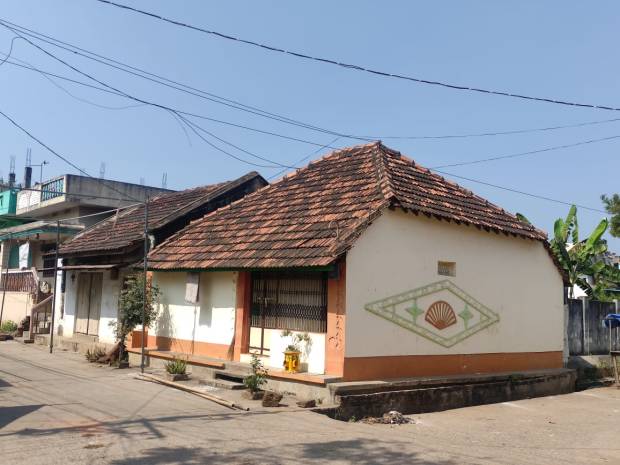
Pulugurtha Village Scene
The road to the village of Pulugurtha from Kakinada passes through the green Andhra countryside that is a treat for the eyes. Google Maps leads us well. Located near the town of Ramchandrapuram, it was not very difficult negotiating the way to the village. Crossing a small canal – an irrigation canal that provides water to the nearby fields – we entered the village of Pulugurtha. A signboard in Telugu announced the name of the village. It is a little after noon and the road leading into the village is more or less quiet. A few locals on their work are what I get to see. A small shop selling chips and cold drinks and right opposite to it is a two storied building that has The Pulugurtha Handloom Weaver’s Co-Operative Production and Sale Society Limited written on it. Entering the premises, I found a gentleman who said that the shop on the premises was shut and I needed to walk down a little into the village for another outlet. He was busy at work but showed the way to towards the other outlet.
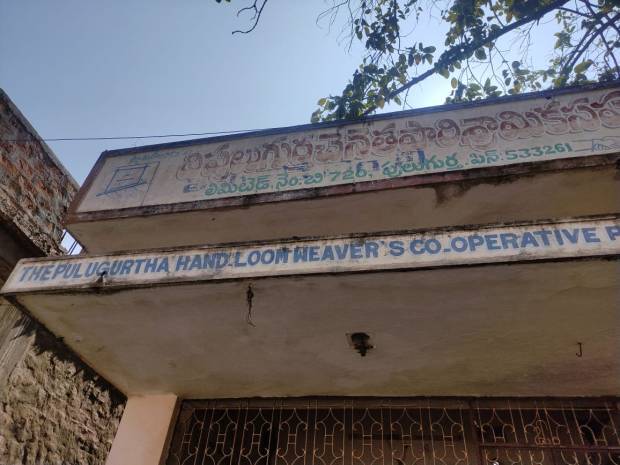
The Cooperative
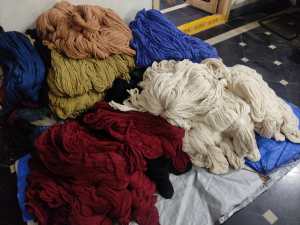
I saw a few beautiful traditional houses, some new structures, paved roads, tall coconut trees in some homes as I walked down to locate the other outlet. It was not very far. A two storied building inside a lane announced Pulugurtha Handlooms, established in 1947. While the building looked quiet from the outside, as I went in there was some activity going on. Two gentlemen were sorting the bales of cotton yarn that had been stacked up in piles in a corner of the large hall. A customer had come to buy white cotton yarn. As he was looking to pick up his choice, a gentleman showed us the yarn. Soft and smooth to touch, he said it was the finest cotton grown in the region.
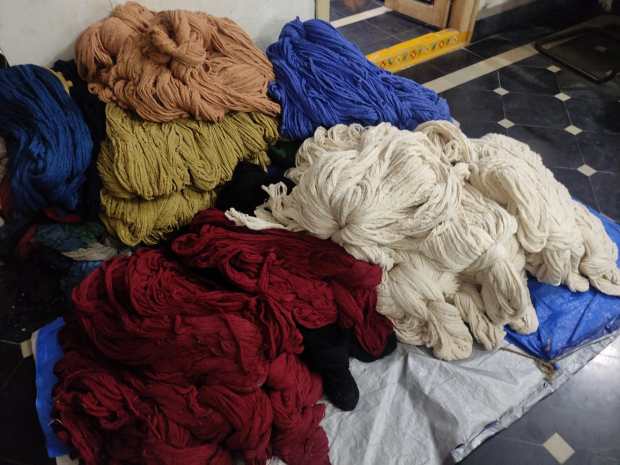
The Yarn
Weavers pick up the yarn from the cooperative society and weave the sarees on pit looms mostly. There were two kinds of sarees that the cooperative had – one a very fine cotton saree that they referred to as the Pulugurtha saree and the other was of the malkha variety. The Pulugurtha sarees were available with zari and without zari Some of the sarees had small butis in zari on them and a few were in plain colours with borders. There was one that particularly caught eye: a beige coloured fine cotton saree with fine red checks. The gentleman who was showing the sarees said that the weavers belonging to Pulugurtha and neighbouring villages were engaged in weaving these sarees. While weaving was a traditional profession, he rued the fact that several young members of weaving families were now moving away from it as there was not much money in it. They were moving off to neighbouring towns in search of work. Many had taken up tailoring. The weaving of a saree is a venture, he said, in which all members of a family were involved.
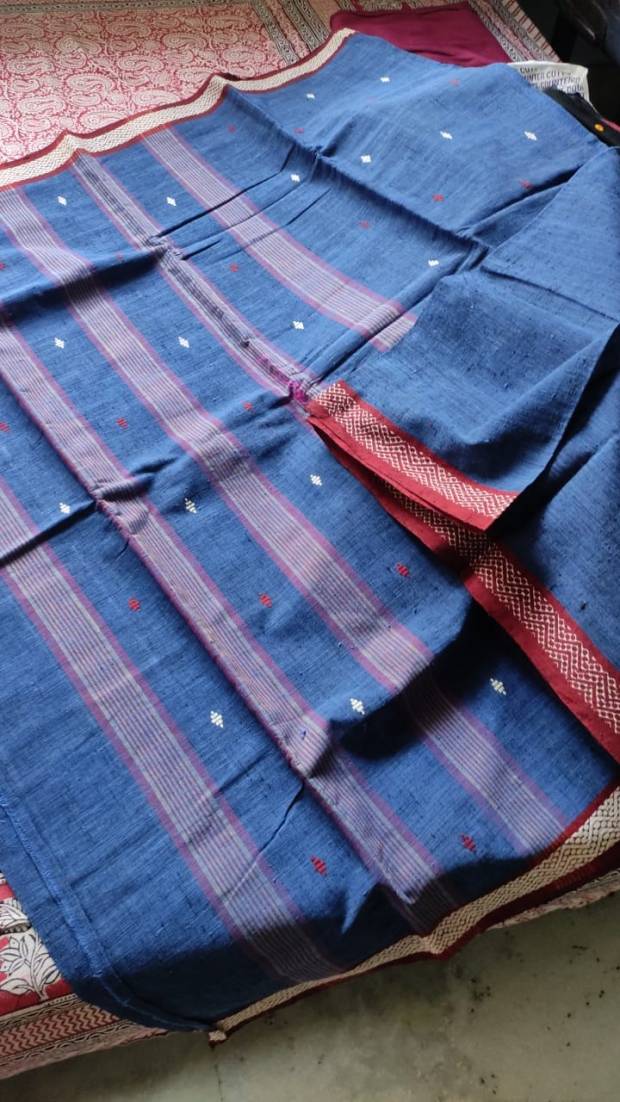
A Malkha Saree
The society had a fairly large quantity of the malkha kind of sarees and dress materials. The word ‘malkha’ is a portmanteau of ‘malmal’ and ‘khadi’. The malkha is a slightly coarse kind of weave that is easier to drape and is much easier to maintain as well. It was introduced to the weavers at this cooperative. The Decentralized Cotton Yarn Trust (DCYT) founded in 2005 by Urzamma has been instrumental in creating the malkha fabric. Weavers in Pulugurtha and other villages in the East Godavari district of Andhra Pradesh have been weaving the fabric which is marketed by the Malkha Marketing Trust whose basic aim is to “to make yarn specifically for the handloom, restore the integrity of the village-based farmer-spinner-ginner-dyer-weaver chain and create a field-to-fabric product that travels to the urban market, with the ultimate aim of transferring ownership of the means of production to the people in the chain.”
Dyes used in making malkha are natural ones and Sivakumar Karra of the Cooperative showed me several sarees and material that used the organic colours. He did go on to say that they were now also using chemical colours as well. Stacks of the kora, the unbleached kind, were lined up on the shelfs in a room of the Cooperative. There is a huge banner inside the building that showcase the detail of malkha and how it all began. The plain ones, he said, were taken and then printed by the DCYT and the Malkha Marketing Trust. Karra said that he had travelled over the country exhibiting the sarees woven by the members of the Cooperative.
When I set out on my journey to Pulugurtha, I did not expect that it would turn out to be a textile story as well, a story of a group of weavers and a cooperative that had been working for years now. In spite of all the hardships endured, work seemed to be going on. The handloom stories need to go on.
Bio:
Nishi Pulugurtha is an academic, author and poet based in Kolkata. Her publications include a collection of essays on travel, Out in the Open; an edited volume of essays on travel, Across and Beyond; two volume of poems, The Real and the Unreal and Other Poems, Raindrops on the Periwinkle; a co-edited volume of poems Voices and Vision: The First IPPL Anthology and a collection of short stories The Window Sill. Her recent book is an edited volume, Literary Representations of Pandemics, Epidemics and Pestilence (Routledge).
***
For more stories, read Café Dissensus Everyday, the blog of Café Dissensus Magazine.


 Café Dissensus

So beautifully written. I found your piece just in time when searching for places where people do hand weave or run handlooms❤️