Can the Saree Speak?
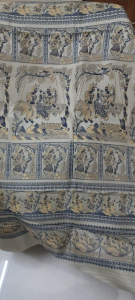 Traditional Baluchari saree with the mythical motif of Radha-Krishna” data-medium-file=”https://cafedissensus.com/wp-content/uploads/2023/07/image004-1.png?w=135″ data-large-file=”https://cafedissensus.com/wp-content/uploads/2023/07/image004-1.png?w=461″/>
By Sharbani Banerjee Mukherjee
What is a saree? To the women of the Indian subcontinent, the saree is not just an attire, an apparel, a clothing to cover her body. Through generations the saree has come to emblematize a message, a stance, a protest and even a statement. The five and a half metres of textile is woven indigenously by weavers in all states of this vast continent, our India. Every state embellishes the five and a half metres of woven cloth with their own culture, their art, and their lives. Where shall we start? If we go to Kanchipuram, we will discover the purest of silk threads woven in the handloom with golden threads in its border and body, crafting a wild galaxy of designs that will confuse the ordinary mind. Flowers, birds, wreaths and even myths are included to give the saree its individual identity. In Kerala, the handwoven lengths are mostly in pristine white with a golden border that are predominantly used as wedding sarees for the Kerala bride. However, all across India the most coveted saree for a young bride is the Benarasi saree that is the trademark of Benaras/Kashi. Most brides dream of draping a gorgeous Benarasi for her wedding, be it vermillion red, maroon, pink or magenta. The material is usually a fine silk called katan or brocade with heavy to very heavy ornamentation on the border, body and pallu/anchal to make it ravishing. Orissa is another site for an extensive range of handloom weaves such as Bomkai, Sambalpuri, or Cuttaki. All these varieties are famous for their rich weaves with minute intricate designs all over the body, border and pallu. They also come in rich colours that are vibrant and gay that off-sets the dry, arid topography while the pure cotton or silk cloth makes it comfortable in the hot and dry weather. Assam has its own rare collection of silks with wide intricate borders woven in its sarees while the Chanderi sarees of Madhya Pradesh and Kota and tie-n-dye sarees of Rajasthan deserve special mention.
Bride in a Benarasi Saree
Intricately woven Sambalpuri Silk
Kanjivaram silk saree
No discussion on sarees can be complete without mentioning Bengal. Where can I begin and if I do, can I end? Bengal is a veritable storehouse of a plethora of styles and genres as far as weaving is concerned. Bishnupur in the district of Bankura is famous for its phenomenal range of sarees of silk and tussar. The butter-soft Bishnupuri silk is woven, dyed and printed in the small town of Bishnupur in a wide range of colours from whites, off-whites, pastel shades to rich and bright colours are found here. The Baluchari saree is a trademark of this town as well which has now become an international phenomenon. It is not only because of its wonderous silken texture but for the mythical representations woven on the body of the saree with intricate stories of the Ramayana, the Mahabharata, Jataka Tales and many such stories. To wear such a saree is a moment of pride for any woman as she feels that she is wearing her culture, her tradition on herself. It also represents wealth as these sarees take many months to weave with great finesse and intricacy on the part of the weaver and hence are rather expensive.
Traditional Baluchari saree with the mythical motif of Radha-Krishna
The cotton handwoven sarees from Dhaniakhali, Fulia, Shantipur, Samudragarh bear clear and separate identities with the quality of their textile and the designs on their border, body and pallu. Batik sarees and kantha embroidered sarees from Santiniketan and its surrounding areas are famous not for their weaves but for the artistic representations crafted on them, with wax in Batik and needle and thread in kantha work. Every saree is unique as the artist gives his/her imagination freedom to create a work of art on five and a half metres of cloth.
Traditional Kantha work on pure tussar
Murshidabad silk is famed for its super-fine texture as it is woven from a special silk cocoon only nurtured in that part of Bengal. The Dhakai muslin and Jamdani sarees of present-day Bangladesh are famed across the world for its fine quality and richness of weaving.
Yet, the trajectory of the saree is the journey of Indian womanhood. Previously, it used to be wrapped around the body in a loose style that helped to cover the body and the head. It was thus easy for Dusshasana to attempt to disrobe Draupadi by pulling her saree in the presence of the full court in Mahabharata when the Pandavas lost the game of dice. In the late 18th century, the sister-in-law od Rabindranath Tagore, Gyanadanandini Devi learnt and taught women to wear the saree in the formal pleated manner that made travel and movement easy for the ‘enlightened’ women as they slowly came out of the purdah system. If we see the old photographs or paintings of royalty of the more than 500 princely states that composed India before Independence we will find royal women, young and old, draped in gorgeous silks and brocades; even little girls were wrapped like bundles with sarees clutched together with stone-studded golden cummerbunds and broaches. The saree came with the dawn of Indian civilization and remains today an important aspect of our culture and tradition.
The saree was also used by many women as a statement of their belief or psychological status. I have heard that my mother lost her father when she was only four months old. My grandmother became a widow at the young age of 23. Granny’s parents were both alive then. Since my granny could not wear any coloured saree due to her widowhood, her mother (my great-grandmother) stopped wearing coloured sarees and only wore white sarees with black borders. Since my mother’s grandfather occupied a very high post in British India, she was occasionally required to attend official parties. She had asked a zariwala to craft a special saree for her. It was a pure silk off-white saree with a narrow velvet border on which intricate designs were done with pure silver and pearls. The saree is still as good as new though the silver has blackened, and the pearls are crumbling. Her decision to wear black and white sarees was her silent solidarity with her young, widowed daughter. It must have given my grandmother the strength to carry on, to restart her education at Dhaka University.
When my mother was getting married, the economic and social status of her family had waned to a great degree due to partition, leaving their home, hearth and belongings, and coming to a new land as refugees. Though they had relatives, it was not like home, not like old times. And yet, how could a daughter of such an illustrious family be a bride without a benarasi saree? So, all her uncles pooled in to buy her a lovely pink benarasi which was beautifully crafted and yet very light. This saree stands as a testimony of the pride of a family who would not let the changed circumstances come in the way of their daughter’s happiness. This saree reminded me of a very significant comment by Hannah Arendt in 1952: “Today’s refugees were yesterday’s citizens.”
My mother’s wedding Benarasi saree
Time flew, my mother became a teacher and with my father they built a pretty little house and lived with their two children. When I was 15-year-old, my mother went to Calcutta for a school meeting and brought back her first truly expensive saree, a pure tussar with Cuttaki weave on the border and pallu. It was a statement of her success as an independent woman, an identity of her own, a time when she could actually buy something for herself without neglecting the needs of her husband and children.
The tussar saree with Cuttaki border and pallu that my mother bought for herself
When I went to study at the university I saved from my monthly allowance and brought home a muga saree for her. I was 19 and my mother was so overwhelmed that she wept with joy. When that saree became too old to wear outside, she stitched it into a wrapper to commemorate her first saree from her daughter. Sarees are sagas of love, longing, nostalgia, and memory. If we could take interviews of women of every cross-section of society, we will discover how sarees are a part of their history, an integral aspect of their memory.
Over the years I have grown a very large collection of sarees from every corner of India. I could go on for ages if I started talking about each and every saree, how I got it, whether it was gifted or bought, whether I inherited them from my mother, whether I wrestled and wrangled with the seller to get an expensive saree at half its price. I could give a list of who envied or appreciated my saree, which defined my relationship with that person. To me saree is an identity, a saga that a woman nurtures within the secret vaults of her memory. The sarees connect a woman through her travails in the long journey of life and every saree has a story. If sarees had a voice, they could write a large collection of short stories about the anecdotes of women who wore it. That is why I repeat my title at the end that the saree has a silent voice that is audible only to the receptive listener.
Bio:
Sharbani Banerjee Mukherjee is an Associate Professor of English at Triveni Devi Bhalotia College, Raniganj. Having teaching experience of more than 30 years, she has published a number of articles in journals of national repute. She has delivered lectures, webinars and presented papers at National and International seminars.
***
For more stories, read Café Dissensus Everyday, the blog of Café Dissensus Magazine.


 Café Dissensus

Sharbani Banerjee Mukherjee, what a great piece of article ! love your tone of writing…you’re blessed with a creative mind indeed . Moreover I’m affected by a sweet nostalgia…the way you have narrated the saga of sarees from generation to generation that exists somewhere in almost every Indian girl’s life.