Pacts, Hashtags, Saree Sisterhoods: Revival of Saree on Social/Digital Media Vis-a-Vis My Saree Journey on Instagram
By Pratibha
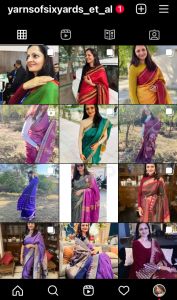
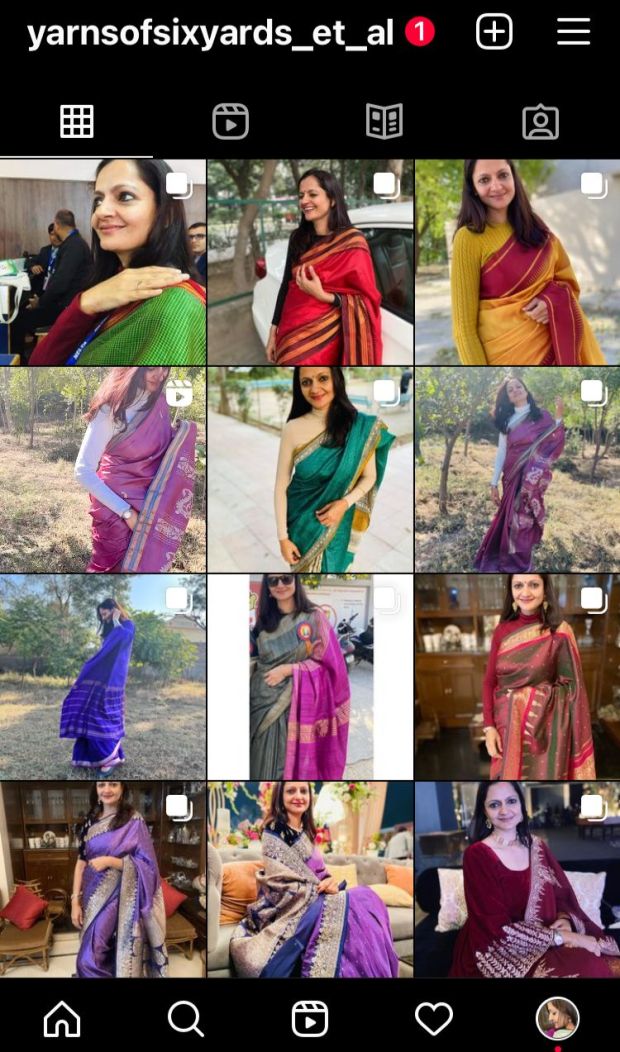
It was in 2018 when a friend suggested offhandedly, I should have my own Instagram page with the ‘niche’ being sarees. The context: I used to wear sarees to work almost every day and post a picture as my WhatsApp status along with the information regarding the weave, the particular Indian state the saree belonged to and my own saree story attached with that #sareeoftheday. My friend saw this and apparently enamored with my handloom sarees collection, said one day, “You should catalogue your drapes through permanent posts on Instagram instead of WhatsApp where the photos and information stays only for twenty-four hours before disappearing automatically.” That was the tipping moment and beginning of an enriching virtual expedition for me. Succumbing to the exciting inkling of having my own IG page, I created @yarnsofsixyards_et_al – a moniker chosen very thoughtfully by me after mulling over it for days as to what should be the name of my handle – ‘yarns’ being the homonym here, meaning both a ‘thread used for weaving’ and a ‘story’, albeit a bit rambling and implausible! That’s what the idea of the page was, as I embarked on this virtual whirlwind with great exhilaration and four years and ten thousand plus followers later (though the latter is no yardstick of success), it has left me more enriched, more informed and more aware about the Saree, the distinct marker of our indigenous and material culture!
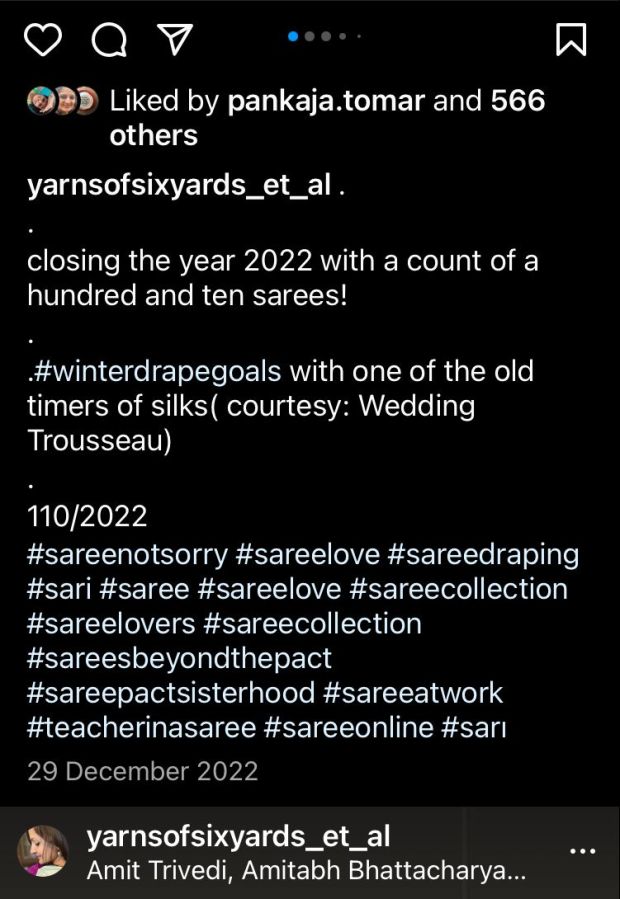
Although being a late bloomer on Instagram as it had already been there for some time, a whole new world opened up before me as I started exploring this space for my saree journey as a low-key patron, enthusiast and lover of sarees. While it took me some time to understand the nitty-gritties of how to “engage” with the like-minded bloggers or how to create my own ‘content’ (falling prey to the pressure of making myself more visible and creating expectations for myself), things eased out a bit for me when I just decided to be myself and it finally started to cotton on. I started enjoying this as I trudged along the path, making a slow start, sauntering my own way, finding my own feet, learning about the power the whole virtual world entailed. I began to understand the momentous role and power of digital/social media platforms in the revival of the saree, in its capacity to reach out to millions in no time. It was like a revolution of sorts – one of the firsts being the “100 saree pact” between two friends, Anju Kaddam and Ally Matthan. A small promise made to each other to air the sarees languishing in their cupboards at least 100 times a year, their move to go online into the virtual world with their idea created history. Out came sarees and their stories from the coffers of women far and wide blurring the boundaries of class, status, countries, and communities – urging and inspiring more and more women to jump onto the bandwagon. The way social media connected the women around the world while they bonded over their sarees and stories with great fanfare and fervor was contagious and magical. Anju Kaddam ended up being a Ted speaker, dedicating the idea to her mother, the most loyal saree connoisseur she had seen, wearing a saree everyday effortlessly carrying out her chores with the ever falling stubborn pallu but never switching to any other attire. Then started a tide of related movements and a kind of pleasurable, non-competitive upmanship game among ‘saree sisters.’ As the saree entered the world of hashtags, digital spaces strewn with individual narratives attached to sarees combined with the collective efforts of the saree wearing community catapulted saree onto the centerstage. Women started cataloguing their drapes, numbered them, counted how many sarees were worn in a week, month or year bringing forth the mini sagas attached with each one of them. #sorrynotsorry became #sareenotsorry and #saree or #sari alone have reached more than a million posts on Instagram. Then there were saree themes, celebrating a particular weave started by various saree bloggers, celebration of festivals, commemorative days, and life in general wearing a saree, It creatively created pretexts, nudging the fellow saree lovers to pull out the sarees from their closets, joining the themes by draping those and become recontours in their own right adding words to the preen and primp saree pictures. The first theme saree that I draped was for the ‘Maheshwari weave’ from Madhya Pradesh. The week-long theme brought together so many stories and different kinds of Maheshwaris enriched with the plethora of information and knowledge sharing about the origin, types, names of different Maheshwaris, etc. Soon after, I draped a Gadwal Silk and passingly tagged Nalli Silk Sarees in the post, the source of that saree. Next morning, I woke up to a flooded DM section congratulating me for getting featured on Nalli Silks official page. The experience was exhilarating to say the least and it motivated me to air my sarees more often. Meanwhile, there were more saree themes like #ikat_ki_bahar #tieanddyestories #splendourofodishaweaves #themajestyofkosa #gangsofajrakhpur by many popular saree bloggers and the response to the hashtags/saree themes initiations used to be feverish as it kept adding to my limited knowledge about our beloved six yards. There would be themes related to colours, e.g., #greenforsawan #blackforsankranti #9coloursofnavratri #yellowforbasantpanchami, etc., making the entire spectacle much more than just aesthetics, going above and beyond to connecting the threads of saree wearing with our seasons, cultural heritage and flavours, festivals, food et al. There was even a #sareeinginthetimesofcoronaquarantine hashtag theme created by Anandita, a saree blogger from Canada which made women, including me, drape sarees even during quarantine days. This proved to be a pandemic positive theme to keep us spirited and cheerful in the low times, by looking forward to getting dressed at least once a day. There have also been themes like #maakisaree where bloggers wore the sarees of their mothers pouring out the emotional quotient attached to them. Sarees as old as forty or fifty years old have been proudly draped and displayed leaving one mesmerized on the longevity and sturdiness of sarees being top notch as compared to the other attires of the world. I have also seen posts on ‘travelling sarees’ pertaining to one saree that would travel from one wearer to the other, in the bid to promote borrowing and repeating of the saree and also to make the maximum CPW(cost per wear) of the saree by making it worth the money it was bought for, rather than making them decay and give way, locked in the dark almirahs.
Virtual also spilled over into the real and women started having #sareemeets deciding upon themes and particular clusters/weaves. Not only that, it did not only bring together women all across the world just “talking about sarees” as some would trivialize this to, there were exceptional learning avenues opening for novices like me to learn about this most ancient and indigenous attire, like the very illuminating one week series on Jamdani weaves (virtual interviews and videos) done by Shwetashree, an IP lawyer from Delhi, better known by the name of her handle @Sareesamurai. In this series on one of the most exquisite indigenous handloom weaves, the Jamdani, Shwe brought on board several award-winning experts, researchers and weavers who had done path breaking work in the field of this traditional weave. This entire series was a veritable treasure trove of knowledge and authentic, well-researched information on Jamdani sarees. Then there were virtual talks/interactions/live sessions by experts on various fabrics, textiles and handloom sarees of India, series of carousal posts dedicated to a particular cluster with all the details of its warp, weft, history, cultural heritage, etc. I particularly learnt about Dhonekhalli, Begumpuri, Khes from Bengal; Bobbili and Kunbi from Goa; Jagatsingpur Sutaluga, Sambhalpuri Bandha, Khandua, Santhali, Dongria, Behraampuri, etc. from Odisha; Sangudi of Madurai, Kosa from Chattisgarh, Kasuti embroidery Ilkals, Radha Ramanna handloom and Patteda Anchu sarees originating in the handloom hub of Gajenragarh in Karnataka, among many others.
Then there were handles aiming at normalizing saree wearing in daily life, or bringing out a revelation how versatile saree is, teaching various different methods and ways to drape a saree other than the usual nivi drape or advocating a fusion of saree with other attires – saree occupying the rostrum all the while. Several individual as well as group pages contributed to this saree revival spree in their own unique ways. The very popular Six Yards and 365 days started by one of the most discerning saree aficionados, Sunita Buddhiraja, who unfortunately lost her life to COVID-19, created this platform for women to share the sarees hidden in their saree wardrobes. Her own personal collection was monumental and a legacy in itself to be carried forward by the thousands of connoisseurs who did her bidding by draping and describing their sarees. Saree Speak, another community of saree enthusiasts started by Vini from Goa, is always seen having fun around sarees. Individual pages such as the eponymous VijayalaxmiChhabra (owned by Mrs. Chhabra, former Director General of Doordarshan) and Afsarnama by Ms. Susan Thomas (IRS officer and Director, NIFT Bengaluru) are the veritable encyclopedias on sarees, Indian handlooms and textiles keeping the faith in the virtual spaces intact with their coffee-table-book-worthy content. It’s just not possible to have enough of their posts on aesthetics amalgamated with nuggets of wisdom imparted through short vignettes from the wide spectrum of their rich experiences and highly accomplished lives. Personally speaking, these pages have not only augmented my knowledge on sarees but also helped me understand the nuances of life through the knowledge and skills of these empowered women – living legacies of professionalism, competence, proficiency and expertise. It is inspirational to get to know about more and more women who have been successful trail blazers in their own respective fields, navigating the treacherous corridors of the patriarchal world, creating a niche for themselves. My Instagram page and how I ventured through it in the quest of information related to sarees has been a medium for me to familiarize myself with these success stories in the women’s world. Sarees and social media, especially IG, has helped me go beyond the visual at a certain level, empowering me with a better understanding of the world through these very motivational posts and stories that are always flowing from these pages speaking of the robust oeuvre of these very inspiring women like Ms. Chhabra and Ms. Thomas.
I have also learnt about many treasure weaves of India through this platform and added them to my collection, buying directly from the weaver clusters. Right knowledge, right information and right people make digital media in general and IG in particular a force to reckon with, despite the presence of sleazeballs and blithering idiots creeping into the DMs of women always making one doubt the relevance of one’s digital presence and footprint.
Of course, there is a slippery slope of being a mindless hoarder in the name of patronizing the handlooms and the saree, but one has to constantly be in charge of one’s discretion. Started as the hallmark of IG and proudly used by the echelons, the word ‘influencer’ became somewhat pejorative over a period of time. In the name of revival of sarees and supporting the weavers, high end brands sell sarees at triple the original price capitalizing on the number of followers of the big saree bloggers, the ‘influencers’. Then there is a risk of being misled by less informed and self-proclaimed saree experts sporting fake handlooms/weaves. The key is to be watchful, keep a close eye on the quality of content to be followed and keep learning, creating a solid base about the knowledge of handlooms and textiles, brick by brick.
There is also a ‘saree constabularies’ kind of faction on socials which berates you for not wearing only ‘handlooms’ and donning any kind of ‘power loom’ sarees. A general repulsiveness pervades around some ‘highbrow’ circles of saree wearers regarding wearing anything else than handloom. I have no trepidations in admitting that I, too, fell prey to such chauvinistic validation and understood that as a saree blogger, it’s a blasphemy on my part to wear or promote anything but handlooms. But luckily good sense prevailed soon and with time and following the content of some conscientious content creators, came the understanding that it is important to not downplay power looms and mill sarees as they have been able to retain and keep intact the saree wearing among a particular category of women who could not afford handlooms. Not every saree in your wardrobe can be a handloom saree, and it is not a crime to take out #fauxgeorgettes or #gharkisarees to suit oneself, sometimes during a particular weather like monsoons that is a deterrent for saree wearing. Thoughts like those were so comforting and it made me at ease with a kind of ‘saree inclusion’ of sorts by wearing all kinds of sarees.
I dedicated several posts as my odes to the never-worn, less-worn, gifted-and-not-much-liked kind of sarees, completely convinced that they too, played a part in the entire saga, the trajectory, the odyssey of six yards by virtue of their existence. This ‘saree inclusion’ was really liberating as I started wearing all my sarees without a self-reproach or qualms and aired all of them, just to keep the sareeing going. Hence some conscious and sensitive people on IG steered me towards retaining the simplicity of saree wearing as it is, away from the elitist appropriation of the saree. Affordable sarees keep saree wearing going for all women, the ones who don’t know about the exotic weaves or can’t afford to buy exorbitantly priced ones but continue their loyal patronage to sarees nonetheless. Saree is for everyone, and saree is a great leveler of sorts in this sense. What I also learnt as a part of my journey on IG was the concept of “unblouse” which means normalising wearing sarees with “non-matching” blouses. In fact, this was another therapeutic learning that one can drape a saree with just anything – a crop top, a peplum, a tube or a tank top, a denim shirt, even long kurtas. This learning grew multifold as I kept observing unusual saree drapers as to how versatile and experimentative they could get in exploring the saree and saree drapes. I had, for the longest time, roamed in the markets to find the 2*2 rubia in exactly a matching shade of the saree for the blouse. It would be so disappointing to not find the desired color in the endless corpus of running material strewn about in the fabric shops. Now this new-found learning made saree wearing breezier doing away with the woes of running around to get a perfect blouse stitched. Got to drape a saree? Simply find the best match for it in your wardrobe among tops, T-shirts, crop tops, etc. and go for it. I literally went on an unblousing spree too and wore my sarees with kurtis, tops and even shirts in my wardrobe. Then pages like eponymous @Poojajagdeesh, @Winnynarayan, @Nupuramarnath and also @Bohobalika by Mamta Sharma Das, etc. also taught a great deal about how to style a saree in a hundred different ways with their creativity and élan around sarees. Then there was a shift and came the era of ‘reels’ and saree bloggers went all over the place with their ‘tips and hacks’ regarding saree wearing, suggestion, advices, or general videos on sarees, making them islands of excellence among the sea of mediocrity of reel makers.
Amidst changing fashions, changed aesthetic norms and other ‘trends’ of the textiles world that sometimes seem so outlandish, saree is something that remains the epitome of elegance and poised refinement. I have also learnt a great deal on IG about saree being a sustainable apparel, much that we need this buzz word in our times. An out-and-out zero waste single garment, sarees are designed to conform to all shapes and sizes and hence very inclusive, accommodating everyone irrespective of the race, gender, sexuality, ability, body shape or size. In its being a free size garment it also keeps our waistline woes at bay! Having said that, it’s still a bit underrated in this sense of the word and various domains, spheres and circles of our lives need to really wake up to the glory of this wonder garment!
Although the ennui has appeared to have set in and they say Instagram too, is past its shelf life like Facebook. This holds good for everything that starts with a bang and is exploited fully before turning into a mass of redundancy and listlessness, as in the case of some defunct social media platforms. Nevertheless, it has left its mark and the social media have played the role of a catalyst in the entire digital eco system towards the revival and resurgence of sarees, especially for the young generation, for it is imperative to pass on the baton to them if we want our traditions, customs, cultures, and heritage alive – saree are a major constituent of our indigenous identity and consciousness!
Bio:
Dr Pratibha is Assistant Professor of English at Kishanlal Public College, Rewari, Haryana, India. She has several academic publications to her credit. Her Instagram page @yarnsofsixyards has more than 10.2k followers.
***
For more stories, read Café Dissensus Everyday, the blog of Café Dissensus Magazine.


 Café Dissensus

Wow, very enriching journey of your saree .it’s really helpful and motivating to wear a saree on daily basis
Thank you for your response!
Happy Saree-ing! ❤️
Wow, very enriching journey of your saree .it’s really helpful and motivating to wear a saree on daily basis
Amazing read. What a revival of the saree. Loved reading your article