The Saree as School Uniform: Narratives of (Dis)empowerment?
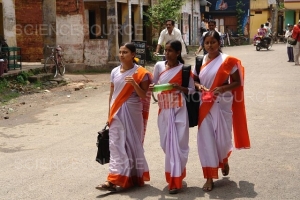 Schoolgirls in Sari Uniform” data-medium-file=”https://cafedissensus.com/wp-content/uploads/2023/07/image002-2.jpg?w=300″ data-large-file=”https://cafedissensus.com/wp-content/uploads/2023/07/image002-2.jpg?w=620″/>
By Sunrita Chakravarti
Sometime in 2018, fashion designer and entrepreneur Sabyasachi Mukherjee addressing a group of Indian students at a Harvard India Conference remarked, “I think, if you tell me that you do not know how to wear a sari, I would say shame on you. It’s a part of your culture, (you) need to stand up for it.” The designer was severely criticised by a section of netizens for burdening women with the responsibility of upholding Indian ‘tradition’ and ‘culture’. The reason I begin this piece by referring to this incident is that it allows me to frame certain questions – questions which have both deep personal and social significance. When I was asked to pen a piece for this issue, I was ill at ease, to say the least. Growing up, I have had a complicated relationship with the six yards of “elegance”. As much as I have admired my mother and other women (teachers at school and university) don their handlooms with grace and elan and wished to be that image of perfection, I have been haunted by a sense of trepidation and discomfort. The saree, every time I have donned it, has made me conscious – not only of my body and its somewhat laboured movements (as I have tried to carry it gracefully) but also of my ‘inability’ of draping one – which according to our internationally acclaimed designer is something to be ashamed of. It is perhaps because of this “inability” of mine more than anything else, I have taken very little interest in sarees and traditional weaves and can barely tell apart a bomkai from a gadwal. What could one such as me have to say about the topic at hand? I might seem to digress but this detour seems necessary to pose the questions which will serve as an entry point to the discussion.
In recent years, the media (both print and electronic) has been instrumental in engendering the revivalist trend of celebrating the Saree, especially the handloom, with the lifestyle section of leading dailies showcasing celebrities and actors undertaking the #100 saree challenge or lauding women politicians for donning the traditional weaves. The media can be credited for the fairly recent discursive construction of the saree as ‘empowering’ and the saree clad ‘modern’ woman as exuding “femininine power and grace”, aided by the strong visual impact of the images of a Nirmala Sitharaman, Draupadi Murmu or a Mamata Banerjee in their handloom sarees. It is in this context that Sabyasachi Mukherjee’s comment needs to be viewed. It is partly in response to this celebratory discourse of ‘empowerment’ attributed to the saree that I wish to evoke the very ordinary, everyday and mundane white saree with blue/red or green border (in most cases) – the school uniform for girls (chiefly from 9th to 12th standard) – and muse on questions of ‘inablity’ and ‘empowerment’, ‘femininity’ and ‘tradition’.
Girls in plain white sarees with coloured border, their hair plaited neatly, with school bags on their shoulders was a familiar early morning sight in both urban and rural West Bengal even a decade ago. The saree as school uniform seems to be a typical Eastern India phenomenon, predominantly seen in Bengal and in some parts of Odisha. Though slowly on the wane, the saree is still the uniform for students in higher standards in some government or government aided ‘Bangla medium’ (where the medium of instruction is Bangla) girls’ schools in Bengal. The white sarees with coloured border – the uniform – seems to pave the way for the young girls’ intstitutionalised entry to womanhood. Donning a saree for the first time is that moment of transition from a child to a woman – a moment much fantacized in popular representations, both in film and literature. How do the stakeholders – the students, teachers and the heads of institutions respond to this institutionalised “rite of passage”? Woven into the story of the unassuming white saree are questions of class, the Bangla medium/English medium divide, sexuality and culture which need to be posed at least, if not answered.
Having been to an ‘English medium’ school myself, I distinctly remember the associations which came to mind with the utterance of the expression ‘Bangla medium’. The coloured border white saree generated both interest and an acute sense of difference – a marker of class, perhaps. In the 90’s, when I was growing up, English medium private schools were gradually becoming the default choice of middle class parents who wanted their children to be fluent in English, even if it meant cutting down their other expenses. In rare instances it could be a matter of conscious ideological choice on the part of the parents to put their children in government schools but in most cases it was a question of affordability – the ones who could afford English medium schools and those who could not. Apart from the class factor, the white saree created another sense of difference – we would often be struck by how girls the same age as ours would look so ‘grown up’, almost ‘ladylike’ – as elders would often remark.
How was this experience of ‘growing up’ all so suddenly – a growing up which was aided by institutional disciplinary norms – was it daunting, exciting, empowering or disempowering for those who had to make this transition. Since I have never been an insider to this experience, I turned to friends, colleagues and finally my mother for the answers I was seeking. “At first, all of us were really excited, I distinctly recall how some girls kept on adjusting the pleats and the anchal, asking each other for help,” remembers Somlata Giri,* a teacher at a government college and a former colleague. After the initial days of enthusiam however, the reality struck hard and fast. “It was difficult, not only was the process of draping the cotton saree time consuming in the morning rush hour but travelling long distances in public transport was hard for a fourteen-year-old,” says Giri. Asked what her classmates and students felt about wearing a saree as a uniform, she tells how the majority of the girls wanted the saree to be replaced by the salwar kameez, arguing that the saree restricted their mobility and how the guardians had collectively appealed for a change in the uniform to the head of the institution. Yet there were a few others who cherished the saree, wore it as low as to expose their belly button and were severely reprimanded by the teachers for emulating the “hindi cinemar heroine” (Bollywood actresses), she adds, smiling. Giri’s recollection leads us to a paradox – the coloured bordered white saree seems to be both a marker of ‘tradition’ and has the potential to dangerously veer on the verge of what is deemed to be ‘vulgar’ – a departure from ‘tradition’. ‘Tradition’ is often cited as a reason for justifying the saree as a uniform. I wished to understand the perspective of authority figures on this institutionalised if not disciplinary way in which adolescent girls are expected to carry forward a ‘tradition’ in educational institutions. I spoke to an old friend of my mother’s – Chaiti Das, who had served as a headmistress of a government aided girls’ school for more than twenty years. “Saree is elegant and graceful, the earlier our girls learn to embrace their tradition, the better. Draping a saree is an essential life skill that the Bengali woman must possess. There is nothing wrong if it is through the educational institution that she masters this skill which will help her later in life,” said she. This was precisely the argument that she had to offer when she was approached by a group of guardians who wanted the saree to be revoked as school uniform. As the head of the institution, particularly during the last few years of her service she received repeated requests from the guardians and the students to replace the saree with the salwar kameez which she had turned down. “I vehemently resisted this change as long as I was at the helm, after I had retired the shift was swift,” she recalls. What is remarkable is how she reads these moments of “dissent” to be engineered by ‘forces from within’. Behind these repeated protestations of the guardians and students, she surmises were covert instigations by the young female faculty members, who themselves wished to wear salwar kameez to the workplace – as long as the students were compelled to don the saree and be ‘traditional’ how could their instructors deviate? But what does she make of the issues raised by the dissenters – the discomfort, the awkwardness, the everyday feeling of disempowerment that comes from restricted mobility? She acknowledges that the saree can be quite uncomfortable as a school uniform, but neither the skirt blouse nor the salwar kameez could match its elegance or grace. She also pointed out quite significantly of the disadvantages of the skirt blouse – a common uniform option for English medium schools. “There is always a probability of the skirt riding up… It is not safe, could lead to sexual harassment.” Doesn’t the saree too pose a similar threat of a possible exposure of the nubile female body? It does, she admits with a rider, “but it depends on how you drape it. My staff members and I myself have often chastised those girls who would wear their saree too low, or would pleat their anchals too narrow – the institution must play its role.” The disciplinary role of the educational institution thus seems not only to define what ‘traditional’ is but also curb and control the expression of sexuality – carefully marking the limits of the “feminine”.
For many the white saree with coloured border meant a transition – a complex one. Molly Roy, a neighbour and a friend, tells how the blue bordered white saree, for the first time made her conscious of the male gaze. “It was what ‘growing up’ meant to me, the saree made me aware of my body and their eyes,” she recalls. Both Molly and Somlata recount how some of their friends had been inappropriately touched by male co passengers, especially on those parts of the body which the saree had left uncovered. As much as they love wearing sarees now, they do not think that the saree is an appropriate uniform option for school girls. The everyday struggle was multifaceted. It started with the early morning helplessness of being unable to drape the saree properly, continued with the efforts of maintaining it throughout the day (all the while being aware of the ‘gaze’), and there was always the possibility of being told off by teachers if they failed to do it right. This institutionalised initiation to womanhood and the ‘feminine’ creates a sense of being constrained – both in the body and the mind – a disempowering experience. There also is an economic aspect to this, points out Chaiti Das. It is difficult for the girls belonging to financially backward families to wash, starch and iron the white sarees frequently. “The school’s recommendation of cotton sarees is not a viable option for many who opt for cheap synthetic sarees which are easier to maintain.”
I began this piece refering to Sabyasachi Mukherjee’s remark on the saree. While I am perfectly aware of the context of his remark and have nothing against the promotion of our traditional weaves and handloom industry by contemporary designers, celebrities and politicians, what I found problematic is the designer ‘shaming’ women for not being able to drape the saree. Should the choice of clothes or fashion or ability/ inability of donning a particular attire, be deemed as an indicator of how ‘Indian’/’traditional’ or ‘feminine’ one is? The images of men in sarees, an emerging ‘trend’ in social media platforms are perhaps visual reminders that easy connections between a piece of clothing and a particular gender are problematic. The inability of draping a saree cannot and should not be seen as a failure to imbibe cultural values. Draping a traditional handloom saree can make one feel connected to one’s roots, it can be perhaps an “empowering” moment, but that is often a matter of conscious choice which is informed by class privilege. I therefore wished to look at the night side of privilege and choice, when asked to pen a piece on the saree. When it comes to the school uniform, the question of ‘choice’ is almost redundant, particularly in the Indian context. The students, the main stakeholders, have little or no role in the decision making process. As I muse on the question of choice, I will move several decades back, to the mid 1960’s, when my mother was a school student. I have never seen her wearing anything else other than a saree to her workplace, a government aided college. Yet recalling her experience of wearing the saree to school, she says, “I absolutely detested it… found it immensely difficult to drape, so after the first few days, I never wore it. I continued wearing the skirt blouse (the uniform for middle school students).” How did the school authorities react, wasn’t she reprimanded for flouting the discipline, while others adhered to it? “Yes, I was, but very gently, the teachers were very lenient with me because I was a good student,” she said. I was amazed – this was during the 60’s, when the institution was gracious enough to grant a ‘choice’, albeit selectively to a few based on their academic performance! Undoubtedly it was unfair but the fact that some had a choice, that too in the 60’s is noteworthy.
The saree as school uniform is steadily losing the battle to the salwar kameez in Bengal over the last decade or so, as government and aided institutions had to give in to the demands of guardians and students seeking a revision of the old uniform. With the issue of gender neutral uniforms being gradually raised by feminists and child right activists and some states like Kerala taking a step forward to actually implement this at government schools, the focus will be on comfort and inclusivity in the years to come. When I asked my respondents about their opinion on gender neutral uniforms, I received mixed reactions. “Ideally that should be the right thing to do, but some girls with heavier, curvy bodies will not look good in shirt and trousers,” remarked Somlata. This was seconded by other friends and colleagues I spoke to. It is interesting to note how they almost unsconsciously associated the term “gender neutral” with the shirt and the trouser. When I spoke to a teacher of mine about these responses, she remarked, “Physical appearance and looks should be the least of a teacher’s concern. Teachers must steer clear from body shaming. As teachers we must erase differences, not focus on them.” In educational institutions, one musn’t feel inhibited – whether in the body or in spirit, neither should one be bogged down by a crippling sense of difference that disempowers. The story of the humble white saree with coloured border is a story of the everyday, ordinary yet daunting struggles that teenage girls go through daily, on their way to school.
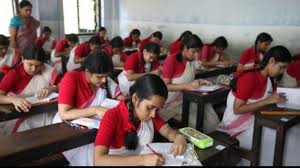
Schoolgirls in Sari Uniform
* All names of the respondents have been changed.
Bio:
Sunrita Chakravarti is an Assistant Professor in English (WBES). She has served at Chandannagore Government College for seven years and is currently posted at Durgapur Govt College, West Bengal.
***
For more stories, read Café Dissensus Everyday, the blog of Café Dissensus Magazine.


 Café Dissensus
