“It takes the shape that you are”: Reading the Interface between Sari and Transnational Identity Formation
 Source: YouTube” data-medium-file=”https://cafedissensus.com/wp-content/uploads/2023/07/image013.jpg?w=300″ data-large-file=”https://cafedissensus.com/wp-content/uploads/2023/07/image013.jpg?w=620″/>
By Nilanjana Chatterjee
“Come now, let’s follow just a few of her threads as she weaves her endless saree of life, for we all start at one end and finish at another. We all are connected in this garment, threads on her celestial loom of humanity.” – Saree, Su Dharmapala (2014)
Introduction
Although dress, for both men and women, is a potent cultural statement, women (perhaps) ascribe more meaning to it in expressing their sense of belonging. Moreover, dress and cultural identity of transnational women are more nuanced: one shapes and re-shapes the other and vice versa, thereby signifying a transnational woman’s social, political, and intellectual belonging wherein the territorial positioning is ‘always already’ (Heidegger, Being and Time, Trans. MacQuarrie and Robinson, 1962) in a fluid state. The present essay, in the context of Indian transnational woman studies, uses sari (a literal and metaphorical rite of passage for Indian women) as a tool to understand the complex dimension of an eminent transnational woman’s identity formation. Annette Philip, the Keralite Artistic Director of Berklee India Exchange at Boston, has been positing sari as a strategical means to articulate her multifaceted identity formation. As an Indian American thinker, she has experimented with various ethnic music forms pertaining to diverse culture groups. However, when it comes to choosing a dress code, Philip consciously chooses sari. For her, sari is more than a dress: it is a form of text that defines her, gives her a cultural identity, transforms her, empowers her, holds her and most importantly, becomes her. The present study makes a close reading of this interface between sari and Philip’s transnational subject position. The study (perhaps) is significant as it offers meaningful insights into an Indian American woman’s intellectual disposition, her sense of belonging and her ideal notion of human existence on earth.
Sari for Art’s Sake
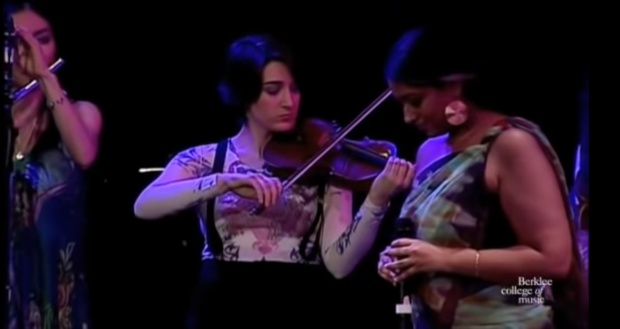
The Artist Director, Annette Philip, chooses sari as an attire to represent her cultural identity in every transnational event she participates. It is a conscious choice she makes. For her, sari is more than an attire: it is a strategical rejection of the dress culture that dominates the American market system. It communicates her sense of cultural belonging – the Indian indigenous ecomusicology within the dynamics of global ecomusicology. As she collaborates with international indigenous musicians and cultural innovators, during the performance of “Dere Na: Women of the World” at the Berklee Performance Centre (Boston, MA), Philip strategically drapes herself in a multicolour abstract marble print sari in earth tone (drawing inspiration from colours found in moss, soil, rocks and trees) to signify her intellectual, cultural and political standpoint. The sari prepares the mood of the concert. The ten-piece core ensemble presents a collage of folk and traditional music from world’s twenty-one indigenous languages with the intention of engaging in a movement (at local and global levels) that upholds world peace and unity amidst rich eco-diversity. Philip’s sari, literally and metaphorically, represents the diverse shades of nature but also marks her unique belonging to the Indian ecology and culture. Philip in earth tone sari stands out in the concert making audible-and-visible her artistic choice of preserving earth’s ecology by valuing her Indian indigenous ecology. Sari becomes a convenient means for Philip to communicate her Indianness, but eventually it becomes the end. Philip projects sari for its very thingness.
Sari for Sari’s Sake
Source: YouTube
For her 2023 Grammys Red Carpet event, Philip chooses bright a green sari with wide gold border. Dress being an immediate culture statement, Philip draws the attention of the emcees at the Red Carpet as soon as she arrives. The very first question that follows is: “What are you wearing?” Philip asserts:
This is a traditional Kanjeevaram (emphasis added) saree from India. So, it’s created by certain weavers (emphasis added) in our country and am happy to wear my country (emphasis added) and my culture.
Philip’s negotiation between Indian sari and transnational public space can be better understood with the help of Appadurai’s 2006 essay titled “The Thing Itself.” Appadurai observes, “The challenge for India’s artists and critics is to find path-ways through the global market without losing entirely the magic of materiality and the unruliness of the world of things. This unruliness thrives on the ephemerality of the artwork, the plenitude of material life, the multiple forms and futures that the social life of things can take, and the hazy borders between things and the persons whose social life they enrich and complicate” (21). Philip’s cultural articulation of sari as an object vis-à-vis an art form is a meaningful way of negotiating the unruliness of the dominant international clothing market and the ephemerality of sari as an artwork. Philips not only projects sari as a mark of her Indianness but also underscores the making of the ‘thing’ (Appadurai). Highlighting Kanjeevaram sari as a weaver’s produce, in a Grammys Red Carpet Event, is Philip’s potent way of drawing the world’s attention to a powerful but hidden fact that the sari is traditionally (in this case, almost a four hundred year old Indian tradition) woven in a certain Indian loom by certain Indian weavers using certain Indian technique (here, adai technique) inspired by certain Indian motifs (here, the sculptures of temples from the town of Kanchipuram in Tamil Nadu). In so doing, Philip upholds the certitude of sari as an abstract-and-concrete ‘thing’ by striking a fine balance between its making and its symbolic value. The certitude of the sari seems to pass on from the sari to its wearer. In the process, the ‘thing’ called sari not just becomes the signifier of Philip’s cultural association with India but becomes the signifier itself.
Amidst other traditional Indian clothing, Philip uses sari as a tool to communicate her unique subject position within a transnational context. Here, the ‘thing’ becomes the thing itself: Sari, for, Philip, transcends cultural affiliations and attains an identity of its own. As the director of the “A.R. Rahman Meets Berklee” concert, Philip drapes a red sari as she and her team pay tribute to Grammy and Academy award winning Indian composer, A.R. Rahman at Symphony Hall, Boston. While vocalists and musicians, of transnational origins, drape in Indian traditional clothes (women wearing white and red ghagra-choli and men wearing white kurta-pyjama), Philip wears a red sari in contrast to her team.
Source: YouTube
All the three dress codes – Ghagra-choli, Kurta-pyjama and sari – represent Indian culture and tradition and therefore sari here becomes the signifier of the signifier. Philip in sari stands out highlighting the significance of sari for sari’s sake. In this process, she also makes visible the role of sari in making her own self. She, here, persists in wearing sari to feature her unique position as the director of the event wherein sari becomes an important axis of her position, identity and liberty within the mainstream transnational cultural hierarchy.
Sari for Existence’s Sake
In the previous section, we have perceived how sari becomes an objective correlative for Indianness and in the process becomes the object itself. However, in the present segment we can see that sari becomes Philip herself. She, in a unique video dedicated to sari, “Sing the Thing,” explicates, why she wears a sari:
Why I wear saris? I actually think saris are the most sophisticated wear for women… The beautiful thing about a sari is its six yards of cloth and it embraces you. So, it takes the shape that you are [emphasis added] … It is my personal view… I’ve helped drape saris on people from all over the world and there’s not a single woman who doesn’t feel gorgeous and just well put-together and beautiful in the sari. So, I like that the sari accepts you as you are [emphasis added].
Source: YouTube
” data-medium-file=”https://cafedissensus.com/wp-content/uploads/2023/07/image013.jpg?w=300″ data-large-file=”https://cafedissensus.com/wp-content/uploads/2023/07/image013.jpg?w=620″ loading=”lazy” class=”size-full wp-image-8712 aligncenter” src=”../../../../wp-content/uploads/2023/07/image013_w-620.jpg” alt=”image013″ srcset=”../../../../wp-content/uploads/2023/07/image013.jpg 1380w, ../../../../wp-content/uploads/2023/07/image013_w-150-h-69.jpg 150w, ../../../../wp-content/uploads/2023/07/image013_w-300-h-138.jpg 300w, ../../../../wp-content/uploads/2023/07/image013_w-768-h-355.jpg 768w, ../../../../wp-content/uploads/2023/07/image013_w-1024-h-473.jpg 1024w” sizes=”(max-width: 1380px) 100vw, 1380px”/>Philip projects sari as taking the ‘shape that you are,’ or accepting ‘you as you are.’ The question is, what do these expressions signify? ‘That you are,’ or ‘as you are’ are the Heideggerian ways of existence – Dasein (Heidegger, Being and Time, Trans. MacQuarrie and Robinson, 1962). And the ways of human existence include both human body and mind. For Philip, sari ‘takes’ and even ‘accepts’ her body and mind. Sari, according to Philip, instead of mystifying a woman, surely and straightforwardly becomes the woman. It takes the shape of her body, her intellect, her emotions, her passions, her thought process – in short, her way of living a meaningful human existence. No other dress – even ‘ghagra-choli’ or ‘kurta-pyjama’ – can possibly agree, accommodate, recognise, and acknowledge experiential human existence. However, Philip as well as the present study do not indoctrinate this idea. It is a perspective that Philip and the study strongly believe in but do not intend to project as a doctrine or precept. Philip’s reflections on sari form the core of her self-understanding – one reshaping the other. As sari helps her to evolve as a human, it in turn evolves from the things signified (ideas associated with a sari) to the signifier (sari as a text) to the thing (sari itself). The understanding of the thingness of sari has (perhaps) helped Philip to better understand her own sense of being and becoming. Philip uses sari to situate herself, empower herself, engulf herself until she becomes the sari.
Bio:
Dr. Nilanjana Chatterjee, Assistant Professor of English in Durgapur Government College, completed her Doctoral thesis titled, “House as Space in the Fiction of Contemporary Women Writers of Indian Subcontinental Diaspora” in 2016. Her areas of interests are Indian English literature, diaspora studies, neo-oriental studies, gender studies, nature studies, and cultural studies. She has published research papers on diaspora studies, neo-orientalism, and cultural studies in some reputed journals of India. She has co-edited Re-theorising Indian Subcontinental Diaspora: Old and New Directions for CSP in 2020. She has authored a monograph on Jhumpa Lahiri and Indian American Domesticity for Routledge in 2022,
and a book chapter on Angami Kire and Ecofeminism for Rowman & Littlefield in 2022.
***
For more stories, read Café Dissensus Everyday, the blog of Café Dissensus Magazine.


 Café Dissensus
