A Panchnama of sarees: the strength beyond self
 ANI Image” data-medium-file=”https://cafedissensus.com/wp-content/uploads/2023/07/runa.jpg?w=300″ data-large-file=”https://cafedissensus.com/wp-content/uploads/2023/07/runa.jpg?w=620″/>
By Runa Chatterjee
Long long ago in the ancient land of Indus, there came into existence a work of fabric called the ‘sattika’. The sattika was an ensemble of three pieces of clothing – a lower garment called ‘antariya’, a modest middle garment to cover the bosom, ‘stanapatta’ and the upper cover ‘uttariya’ used as a veil or to cover the shoulder. It has always been with dignity that an Indian woman has draped these rectangular pieces of fabric which with time have metamorphosed into the almost nine-yard-long yarn and renamed as the ‘saree’. It is, in fact, a must have warp and woof in every Indian woman’s wardrobe.
Now well into the twenty-first century, December 21 is no longer observed only as the day when our beautiful Mother Earth dons the longest night and shortest day but also the day of celebration of draping the longest nine-yard-fabric by every fashionable lady – the World Saree Day!
Sarees, like their immense span, have a long story to weave. The memoir of the saree, so to say, the ‘Sarismriti’ dates back to the Indus Valley civilization from whence it has traversed through the Rig Vedic era and thenceforth made a permanent passage to India. Age, invasion, plunder, and colonization have not been able to wither it; fashion has not been able to stagnate it; politics has not been able to oust it. For the Indian women, the saree still remains the symbol of dignity and femininity.
The Indian myths and her stories too spin the same enigmatic saree tales or the ‘saree kahani’. They behold the panchnama of saree strength. Be it of the legendary fire-born Draupadi, the demon destroying Goddess Lalitha, the peace and prosperity bestowing Goddess Indira or the lifesaving Saint Teresa, all female power is wrapped in the integral symbol of femininity – the saree. Through the saree is bestowed ‘Shaina’ – God’s grace, the immensely beautiful.
Yajnaseni, better known as Draupadi, was a lady with exceptional beauty and personality. If for Helen Troy lay burnt, for Draupadi the Kurukshetra lay slain. Draupadi is best known for being the bearer of the longest saree in history as Lord Krishna bestowed upon her whorl beyond whorl of her saree to save her modesty. It is a symbolic assertion of the power manifested in a saree. The immaculate being behind it.
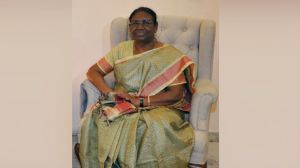
Our current President, the most honourable Draupadi Murmu, is not just a namesake but a lady as erudite as the epical Draupadi and her choice of sarees asserts her strength and belief in freedom. For her swearing-in ceremony, she chose to wear a Santhali saree white in colour complemented by a red stripe on the upper border and a broad green stripe with triangular spikes on the lower side. Santhali sarees are loom woven sarees. They are thick yet soft and are called ‘phuta jhala’. Men too drape them as a dhoti and then they are called ‘phuta kacha’. They usually have a criss-cross of vertical and horizontal stripes on a mostly white base, and the pallav is striped with bright floral and fauna motifs.
Initially the only dye used for the stripes and checks was the rich red made from the powdered roots of the ‘aal’ tree – Morinda citrifolia or Indian mulberry. Currently all kinds of organic dyes are used.
President Murmu is very selective about her choice of sarees. She usually chooses handloom sarees with minimalist but classic combinations such as plain bases with borders in contrast colours. President Murmu wears her saree neatly pleated, draped and pinned up. She intertwines grace with practicality, making her stand out in the crowd.
Borders are important markers of a saree. Borders exhibit a line of control. The entire body of the sari is limned on its three sides by decorative borders. Two of these borders run longitudinally along the sides while the third comprises the terminal end of the sari, and is known as its Pallav.
The Pallav acts as the signified whilst the borders function as the signifiers allowing the wearer to assert a linguistic statement.
The two longitudinal borders usually depict the theme, for example in Baluchuri sarees there might be an intricate embroidery of a hunter and the hunted, but the Pallav will have an explicit embroidery of the entire scene with the forest as its background.
In spite of the endurance by women of aeons of subjugation, struggle, and the assertion for freedom, the gargantuan diversification and evolution of her bearer – Mother India – the saree has always given her strength and bears testimony to her grace and confidence.
One aspect of wearing a saree which has remained constant through this time is the art of gracefully pleating the saree which lends to it the elegance and aura. Sanskrit literature from the Vedic period has asserted that the pleats are an absolute necessity for a woman to be truly a woman. These pleats have to be tucked in at the waist, front or back, so that Vayu, the wind god, can whisk away any evil influence that may strike a woman.
However, there are myriad ways of draping the saree. Just as most Indian Gods and Goddesses are eulogised by their plethora of 108 names, same goes for a sari which can be worn in 108 ways be it the Bengali Athpourey, the Parsi pleats, the Maharashtrian Nauveri , the Assamese Mekhela or the Nivi drape and many more.
The internationally famous fashion designer and politician Shaina Nana Chudasama, popularly known as Shaina NC, is greeted with the sobriquet ‘Queen of Drapes’.
She is an expert at draping the Indian saree in more than 54 innovative styles, and also holds a record in the Guinness Book of World Records for the fastest saree drape. Shaina, the beauty her name signifies, has personified the art of saree wearing. Her highly innovative mind has brought in the concept of ready-to-wear, slip-around-in-a-minute sarees – which are extremely convenient for the busy career women of today.
Every saree has a story to tell. It’s colour, motif, design speak out for itself lending a peek into the labyrinth of the female mind.
Hue is an important factor in choosing a saree. The hue of the saree is a strong indicator in the titration of women’s persona. The various colours assert various occasions and personalities. Every colour in the spectrum allows a prismatic peep of the saree Vista. The pure colours are especially flaunted for religious occasions, while secondary colours become style statements. For example, Goddess Indira Lakshmi, the Goddess of peace, wealth and prosperity, is believed to be very fond of vibrant colours like red, orange or pink, and sometimes green as she represents the woman power full of activity.
The strength of a saree can be judged through the choice of India ‘s saree connoisseur – the dynamic and vivacious Indira Gandhi. Like Goddess Indira Lakshmi, Indira Priyadarshini Gandhi was a lady of elegance and determination. It was because of her that the saree has come to be worn in such an impeccable way.
Mrs. Gandhi’s choice was as kaleidoscopic as India’s saree culture. She wore embroidered garas, printed cottons, khadis, raw silks, temple bordered weaves, Ikats, Baluchuri and Kashmiri needle work saris. Her story narrates that she would selectively choose sarees from the locale she travelled to in order to connect with the people in and around the area.
Draped in her khadi or Sambalpuri sari, she is still remembered as the Iron Lady of India, the pivot of politics, a woman establishing a matriarchal power mantra amidst the totally patriarchal hierarchy. Her sarees exhibited her mind and strength and paved the way for Indian women to wear the saree proudly.
Mrs Gandhi very meticulously chose her sarees keeping in mind the occasion she was wearing them for. On very special occasions, Indira Gandhi would drape the luxurious Benarasi silk sarees. These sarees are an exquisite work of art. They are made of rich silk and bear hand-woven designs of gold and silver. Mostly used for bridal wears, they also assert a designer statement.
Benarasi sarees are traditionally made in four varieties namely organza (Kora), Georgette saree, Shatir saree, and pure silk (Katan). The many varieties of Banarasi silk saree are organza, satin borders, jangla, Brocades, Tanchoi, cutwork, and Resham butidar. These have interesting designs of animals, birds, floral, fruit, human figures, and Persian patterns.
Usually, a Benarasi saree is created by three Weavers. One weaves the body of the saree, the second one handles the revolving ring to make the bundles which are required for the designing of motifs and the third one assists in designing the border. The saree has around 5600 thread wires and all are 45 inches wide. For weaving the warp, the weaver creates a 24-to-26-meter base.
Indira Gandhi raised the status of the saree as an aspiring outfit for today’s women. Her selection of sarees is still in vogue. Her Italian daughter-in-law Sonia Gandhi has kept up the tradition. Her granddaughter Priyanka Vadra still elegantly drapes her grandmother’s sarees. Mrs. Gandhi’s granddaughter-in-law – Varun Gandhi’s wife – Yamini, chose to wear a restored pink khadi sari for her wedding. The speciality of this saree was that it was hand spun and woven by Pandit Jawaharlal Nehru. Nehruji made it for his daughter Indira when he was in prison during India’s freedom struggle.
The saree not only symbolizes strength but epitomizes purity and chastity. For that very reason the Nobel Laureate who believed in ‘service beyond self’, Mother Teresa, opted to serve Mankind in the garb of a loving Mother draped in the saree. Mother Teresa chose to wear a simple white cotton saree with three blue stripes on the borders, one stripe being broader than the other two. She chose the blue colour to associate it with virgin Mary. Mother asserted that she was beseeched to adopt the saree by Jesus Christ as the dress of her Order. She draped the Indian attire in the Bengali Athpourey style. Nuns of the Missionaries of Charity still continue to wear the same designed saree.
This globally recognized saree is now regarded as a Trademark by the Indian Trademark Registry. It was registered on the September 4, 2016, to commemorate the day Mother Teresa was canonized. It was designed by American born Salesian Bishop Louis Morrow after two-year research and is handwoven by the healed leprosy patients of Gandhiji Prem Nivas Leprosy Centre, Titagarh, West Bengal.
A must have in the saree wardrobe is the legendary handwoven Maheshwari saree which traces its origin to the very heart of India – Maheshwar, the capital of the Malwa Sultanate in Madhya Pradesh. It is linked to the royal heritage having been designed by Queen Ahalyabai of the Holkar dynasty. These sarees are unique in their style and design. Some may have a plain base but beautifully designed broad borders which interestingly are also reversible, such as the Baingani Chandrakala, while others may exhibit different kinds of stripes and checks and various motifs all over like Beli, Chandratara, and Parbi.
The Pallav is the eyecatcher. It is vibrant and colourful. It usually has five stripes – three colored and two white placed alternately. The colour spectrum is prismatic ranging between maroon, magenta, mauve, green, and violet. These handloom sarees are very light and airy, the perfect wear for the Oriental climate.
A great admirer of Maheshwari sarees was magnanimous J. Jayalalitha. She used to like three designs in her Maheshwari sarees – vertical lines, bugdi and jala. The first one has vertical lines of golden or silver thread all through the body of the saree, the bugda design features zig-zag patterns of various threads on it. The jala design is like a spider’s web running all over the saree.
Jayalalithaa donned these sarees with dignity and poise much like the Goddess she was named after – Goddess Lalitha, the exquisitely sensuous goddess, also known as Kameshvari, “Empress of Desire”, yet the completely devoted wife of the Supreme Lord Shiva, who is pure consciousness. The Goddess is believed to be fond of sarees with pastel colours, especially the pomegranate red.
Through the journey of sarees thus travels the story of strength and women’s emancipation. Like a palanquin, the saree bears the soul within veiling the body only to reflect the diaphanous feminine persona. Eclectic and diverse, it is this yarn that has spun innumerable tales of sacrifice and determination annealing and strengthening the woman within. The fluidity offered by this apparel of grandeur and majesty allows a woman to make the most authoritative sartorial choices making her feel good and at the same time look good. To quote Amish Tripathi, the famous author of Indian mythology and the Director of the Nehru Centre, London, “When one thinks of the words grace, elegance and beauty, all these words can be replaced with just one: saree.” Thus, the Panchnama of sarees asserts that sans saree sans grace! Vive la saree.
Photo: ANI
Bio:
Runa Chatterjee is a SACT teacher in Durgapur Women’s College, Durgapur.
***
For more stories, read Café Dissensus Everyday, the blog of Café Dissensus Magazine.


 Café Dissensus
