Issue Editorial: (Re)storying Indian Handloom Saree Culture
By Anindita Chatterjee
‘Six yards of splendor/ six yards of glory and tradition/six yards of elegance, beauty and identity/six yards of art/Six yards of attitude/ six yards of allure/ six yards of seduction/ six yards of hypnotism/ six yards of sublimity/six yards of love’ – Sari
As a little girl I loved to wrap my mother’s saree and pose in front of the mirror. I guess every child does the same at some point of their life. Nothing much has changed then. It was my mother who had inculcated in me a love for sarees, and I was deeply inspired by the fact that she took the effort to acquire sarees from almost all corners of the country for her personal collection. She hoped someday I would share her passion and love for the sarees in the same way and share her rich legacy of handloom weaves. The curiosity developed into a strange love and consequently became an obsession that grew over the years. I was deeply concerned when I came to know how the traditional handloom industry was threatened by the rise of the power loom industry. I read about the wide variety and diversity of Indian textiles and how the quite a large number of them were threatened to extinction. Though I had managed to procure quite a large number of sarees, I was not contented for something inside me kept pushing me further. The fascination triggered the researcher in me to undertake a serious academic study which included a research project on the evolution of the traditional Indian saree in 2019 that was funded by the ICSSR, Govt of India, which made me talk to several weavers across the nation, study the government policies and look at the real situation. It was through the research project that I got to explore and learn about the multiple facets of the origin, evolution and journey of the Indian saree.
Saree survives (or rather reigns) from the time of Indus Valley Civilisation and constitutes an integral aspect of the Indian culture. Around 2500-1900 BC, women in the Indus Valley Civilization used to cover themselves with a long piece of cloth, that was found mainly around the western part of the Indian subcontinent. The first portrayal of the ‘draped shawl’ resembling the Indian saree can be seen in the image of an Indus Valley priest who wore a piece of cloth draped like a saree, which was confirmed by archaeologists from a statue discovered from the period. The love of sarees as we can see has deeper roots and is perhaps, genetically coded. The word saree in Sanskrit means a ‘strip of cloth’ whereas śāḍī in Prakrit means cloth material and which was eventually corrupted to become the word sāṛī in Hindi. The word ‘Sattika’ is mentioned in several Buddhist and Jain literatures including the Jatakas to describe women’s attire in ancient India. ‘Sattika’ was a form of women’s attire worn by women in ancient India, which can be seen as an equivalent to the modern day ‘Saree’. In Tamil poetry, one goes on to find graphic accounts of women wearing a kind of drapery that almost resembles a saree. Some sculptures from the first to sixth century AD have also been discovered depicting goddesses wearing sarees. Saree has indeed a long history. It is undoubtedly one of the most popular ethnic Indian garments that enjoy the exclusivity of being reincarnated in various forms. Besides being one of the world’s oldest and perhaps the only surviving unstitched piece of clothing from the past, the saree also has also served as the ‘canvas’ for weavers and printers to create artistic weaves and prints over the time. The Indian saree first finds it mention in the Rig Veda, the oldest surviving literature of the world, written somewhere around 3000 BC.
In the Fashion Bible, Tim Gunn observes how the “The Indian sari; the Chinese Cheongsam, or qipao; the Korean hanbok, the Japanese Kimono have survived for thousands of years. Their evolution is in the textile” (Gunn, 3). The Saree still stays put maintaining a strong statement, both on and off the red carpet. The Roman and Greeks wore old-style togas, chitons or peplos. However, no one wears them anymore and the attire have become outmoded with time. Unlike these drapes which have been reduced to red carpet relics, the Indian ethnic wear saree has remained unaffected despite the changes that have hit the fashion world over the years. A saree speaks of many stories. Woven by artisans with care across ages, in looms, designed by the stitching needle, the saree has always remained an important constituent of the South Asian fashion industry. It is not merely a cloth cover for the body, it is sometimes a distinct ornament and an object of pride of a woman besides having the potential to become a strong power statement.
Sarees have always fascinated me. The touch and feel of the textile have always rivetted my attention since childhood. I was always inquisitive to know about the places of origin and explore the history of the fabrics of India. The Indian handloom industry as we know is the second-largest employment provider for the rural population in India after agriculture. The handloom industry provides livelihood to more than 90 million people in the country. This handloom industry of India is caste based, labour intensive, tradition oriented, having a legacy of unrivalled craftsmanship with a decentralized set-up. This cottage industry has spread throughout the length and breadth of the country. The economics of handloom weaving is shrouded in a web of contradictions between subjective perceptions and objective realities.
Enriched by the weaving traditions of every part of the country, the saree represents a cultural heritage that has indeed come a long way. Besides having a long history of antiquity, saree continues to remain the most popular traditional Indian wear that can make a woman look graceful, elegant as well as fashionable at the same time. It suits all body types and flatters every frame. From the classical Benarasi brocades and Kanchipurams to the hardy cotton taants woven in Bengal, from the extravagantly woven Muga silks of Assam to the finely woven delicacy of Mysore Silks, the sarees of India bespeak of its rich diversity and long-standing cultural heritage. The Indian saree evokes a strong statement, both on and off the red carpet. Bollywood has also served as a constant inspiration for the weavers of India. In this context it might be pertinent to look into the marketing of Barbie dolls in India. In a context of localization through transnational formations, it is important to note that Barbie in a sari that is being sold in India is not an Indian or South Asian Barbie. She is what Mattel Toys calls the traditional Barbie, the white, American Barbie who travels around the world, and has fair skin and blonde hair. She has the standard face, the ideal female Euro-American body, a shiny sari, and a red bindi on her forehead. The side panel on the box reads, “Dressing in an all-seasons classic saree with exotic borders. Barbie is totally at home in India.” This reconfiguration and transformation of Euro American fashion discourse uses the term all seasons to differentiate the sari from the fashion industry in the West, which is organized around seasonal clothes. The term exotic resonates in reference to colonialism, tourism and the eroticization of the female Asian body. Barbie in a sari is material evidence of the movement of transnational capital to India. The doll stands as a Western world’s stereotyped vision of a homogenized image of a multicultural nation; it doesn’t do justice to the rich reserve and expansive variety of the handloom textiles that India proudly produces every year.
In the last few years there has been a grand revival of the ethnic saree as a popular cultural wear across the nation. What started as a pact between two friends from Bangalore, Anju Maudgal Kadam and Ally Matthan, went viral across the globe in social networking sites and other media. Known as the #100sareepact the saree became an Internet sensation, attracting media attention across the world. The #100sareepact gave birth to new forms of friendship in the digital public sphere whereby women across different age groups, cultures, and borders came together to share their personal stories in the virtual space. Due to the resurgence of attention in the traditional ethnic wear several obscure textiles are now being curated and revived by individual efforts, and government agencies, for example the Kotpad sarees from Orissa woven by traditional weavers based in the bauxite prone zone located in the outskirts of Orissa have been invigorated with the help of the Government of India. The Kunbi saree worn by tribal women of Goa have also received a new lease of life due to tireless efforts of saree enthusiasts and textile curators. Movements like ‘Make in India’ and ‘Skill India’ are trying to generate a resurgence of interest in traditional Indian textiles. But against the background of the changing scenario, with handloom facing crisis from cheaper industrial products, time has come for us to take the plunge and save the tradition. Every little effort counts in the process of saving an age-old tradition.
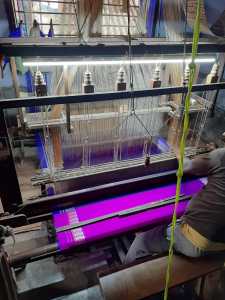
Weaving work in progress, Murshidabad
Photo: Anindita Chatterjee
Issue Editor:
Dr. Anindita Chatterjee, Associate Professor and Head of the Department of English, Durgapur Government College, completed her Ph.D. on “John Clare: Poetry of Madness” from Jadavpur University in 2010. She received a UGC funded Minor Research Project on Representation of ‘modern’ India in the Fictions of Chetan Bhagat in 2011-2012. She has co-edited Re-theorising the Indian Subcontinental Diaspora: Old and New Directions, (CSP, 2020). She completed MRP funded by ICSSR (MHRD, Govt of India) on Sari Story: Dressing the Indian Woman through History, ‘Tracing the Origin, Growth and Evolution of the Traditional Indian Wear.” She has written an article on “Weaves and Voices: Tracing the journey of the Indian Saree” in Textile- Cloth and Culture, (Taylor and Francis Journal), a book chapter on Spiritual Ecology: An Ecofeminist Study of the Jhumur Songs of Tribal Bengal in Indian Feminist Ecocriticism, (Lexington Books). Her areas of interest include British Literature of the Romantic and the Victorian Period, Indian Writing in English, Films, Gender Studies and Popular Culture.
***
For more stories, read Café Dissensus Everyday, the blog of Café Dissensus Magazine.


 Café Dissensus
