Handloom, a Long-lived Tradition
By Suparna Garai
Saree constitutes the soul of every Indian woman’s passion and it has found its way to almost every traditional closet. It ranges from the high street to everyday fashion. The saree takes the form of a canvas where the weaver weaves his dream and reflects numerous designs like embroidery and handwoven techniques. It eventually becomes a piece of artwork which is revered and treasured for ages. India is a multi-cultural country and our women exhibit their identity in what they wear. Modern women are strong, elegant, empowered and independent. Saree forms the core of everyday life for a large population of women of India, and boldly exhibits itself from boardroom meetings at work, to lustrous weddings and sombre funerals. Saree is a part of indigenous Indian culture. HCI celebrated ‘India Day’ with the glory of the Indian loom at the London Fashion Week (15.02.2020) by showcasing sarees from multiple states of India and stating: “It is perhaps closely connected to or roots forming the core of our traditional culture.”
The evolution of a tradition called saree is indeed fascinating. Originating more than 5000 years ago, the Indian saree is considered to be among one of the oldest forms of fashion garments in the world, still in existence. The Vedas (which constitutes the oldest literature composed by mankind) mention its existence and some records from the Indus Valley Civilization also reveal that sarees have a prehistoric origin indeed. Yet, despite being ancient in its age the saree has not lost its popularity.
When the Aryans came into the plains of the mighty North Indian rivers, they brought with them the word ‘bastra’ for the first time. The word ‘bastra’ owes its origin to Sanskrit. The word originally meant a garment or cloth. The women in ancient time used to wear white garment of very thin cotton fabric of 5-9 yards long. One part of which was usually wrapped around their body and the other part on their shoulder across their breast in such a way that one arm and shoulder remained uncovered. The sarees evolved with time and the fashion quotient underwent immense changes with time. Indian fabrics have been exported to Rome, Egypt and China since historical times. Weavers relied upon their humble loom.
There was significant socio-cultural change with the arrival of the British colonisers during the eighteenth century. The introduction of European taste into the cultural milieu of India resulted in fusion of traditional values with the fashion of Victorian England. The women started wearing sarees with a blouse and petticoat. Though it was initially unacceptable and unaffordable to the middle-class women, there was a change in the styling of sarees with time. The trend to pair the saree with a blouse was popularized by Jnanadanandini Devi, the wife of Satyendranath Tagore (image attached), brother of famous Bengali polymath Rabindranath Tagore. The women of the Tagore household popularised the long-sleeved blouses or jackets as part of their distinctive dressing style.
In modern times there are a plethora of ways to tie and drape a saree. Popular Indian actresses such as Priyanka Chopra, Kangana Ranaut, Aishwarya Rai Bachchan, Sonam Kapoor, Richa Chadha, Vidya Balan, Paoli Dam, and Nandita Das have taken saree to the international arena by wearing it to popular events and making it their signature style. As Kiran Millwood Hargrave observes, “India is a place where every color is doubly bright. Pinks that scald your eyes, blues you could drown in.” Therefore, one can also say that to the world of global fashion, saree often resembles a rainbow draped in myriad hues and Bollywood added to its popular appeal across the globe.
‘Handloom’ refers to wooden frames of different types which are used by skilled artisans to weave fabrics, usually from natural fibers like cotton, silk, wool, jute, etc. It is a cottage industry, where the entire family is involved in the production of cloth. Right from spinning the yarn and colouring to weaving on the loom, everything is done by the weavers themselves. Fabric produced from these looms is also referred to as hand-loom. The tools required for this entire process are made from wood, sometimes bamboo and they do not require any electricity to run them. The entire process of fabric production was controlled manually in the earlier times. Handloom is also eco-friendly and dermatologically safe.
The handloom saree in India is varied and culture specific. Some of the well-known Indian handloom sarees are Tant from West Bengal, Kanjeevaram from Tamil Nadu, Banarasi from Varanasi, Chanderi from Madhya Pradesh, Nauvari from Maharashtra, and Bomkai from Odisha. Handloom weaves in India are varied and diverse and no two fabrics are similar. Each fabric is a reflection of the weaver’s feelings and emotions. Every state and region of India has its own distinctive style and thus, each piece is unique in itself. The famous spinning wheel also known as Charkha went on to become the symbol of national identity during the freedom struggle when Gandhiji asked Indians to wear clothes made in India. The weaves were spun on Charkha and it was used mostly by women. Weavers tried to emphasise on home-spun yarn without the use of foreign assistance. This boosted the Indian textiles to a large extent because prior to that Indian cotton was exported to Manchester mills and Indians had to clothes at a higher rate. During the World War I when imported machine made clothes flooded the Indian market, it was Charkha that reinstated the glory of hand-spun and hand-woven clothes. It was a huge turning point in the Indian Independence Movement. Gandhiji said, “The Khadi-spirit means fellow-feeling with every human being on earth.” Following his legacy, India’s current Prime Minister Narendra Modi has crafted his vision of making khadi a national pride and a fashion statement. ‘‘The Made in India’ and ‘Khadi for Nation, Khadi for fashion’ are some popular movements which are trying to reinstill the lost glory of Indian Handloom today.
Today there are many weaving styles that use these fabrics and are referred to as rejuvenated handloom. Since 1985 and especially post-liberalization, the handloom sector has had to face stiff competition from cheap imports and design imitations from power looms. Although handloom shares a long heritage, being an indigenous craft, it is currently threatened with the rise of the powerful machines of power looms. Millions of artists and craftsmen are struggling for existence. Before the advent of Indian industries, the handlooms monopolized the market. However, the machines have replaced the rich legacy of loom because machines can produce ten times faster than the handloom. The poor weavers are forced to negotiate with severe economic crisis to sustain their craft. Weavers have to buy the fabrics and threads from dealers of yarn in wholesale and in this process of production, financiers have emerged as the middlemen in the business of production. They have started to reap the maximum benefit as the poor weaver is gradually fading into oblivion. With the development of advanced marketing strategies, the individual weaver gets little credit. Even though the cost of natural fiber yarn has increased tremendously, the wages of handloom weavers have remained frozen for the past decade or two. Unable to compete with cheaper poly-mixed fabrics, many weavers are quitting weaving and going for unskilled labour work. This is the reason why several weaves have become outdated with time.
Despite several issues and problems, the Indian handloom has somehow sustained itself over the years. India still desperately seeks to hold on to its ancient glorious traditions embedded within heritage, history and culture. With nearly 44 lakh people still working in the handloom industry, it can be safely averred that handlooms would not die a sudden death. Most of the workers are rural and 70% of them are women. However, it is true that almost 100% of them are impoverished and overburdened. According to a social media platform named Uttariya, “there are weavers at the age of 70s and 80s who work for 9-10 hours a day and earn INR 5000-7000 per month for a family, which is insufficient to meet the everyday needs of the family and so they are being forced to opt for other forms of employment.”
According to The Fourth All India Handloom Census, handloom is still India’s second largest employment sector for the rural population. Every weaver is an artist who gives shape to his vision on the textile. Though the weavers have continued to preserve an age-old art but sadly they often don’t get their due recognition and payment. In many cases the benefits and government support seldom reach them. Their standard of living has hardly improved over the years. This has made the younger generation look for alternative employment which in turn has resulted in discontinuation of some age-old legacy and rich familial traditions. Weavers’ stories are often left untold and unheard. Their struggle for existence is often left unchronicled. Some links to untold stories of the weavers are provided below:
One can safely say that saree shall continue to remain integral to India’s rich history and heritage in years to come. Draping a saree still remains integral to celebrating Indian festivals like Saraswati Puja, Durga Puja, Diwali, and many more. Traditionally embroidered Banarasi sarees constitute an essential attribute of Indian wedding ceremonies. To celebrate the rejuvenation of this sector and the spirit of being Indian, National Handloom Day is celebrated on 7th August every year (since 2015). Through such small steps, the government is trying to hold on to a tradition that is part of our rich cultural heritage. It is for our own sake that we need to preserve the rich legacy of Indian handlooms for it is not just about a dying art or decadent glory but about conserving its essence which lies at the very core of Indian culture.
Some relevant images
Ways of wearing saree in ancient times
Jnanadanandini Devi, the wife of Satyendranath Tagore
Women weaving on a charkha
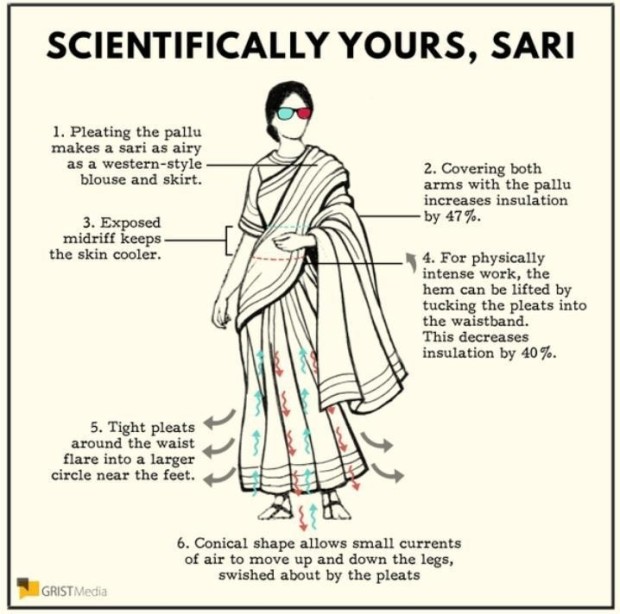
Types of draping a saree
All images have been taken from Google
Bio:
Suparna Garai is an undergraduate student at the Department of English, Durgapur Government College, currently pursuing B.A., English Hons (Semester VI). She shares interest in music and traditional art and craft of India.
***
For more stories, read Café Dissensus Everyday, the blog of Café Dissensus Magazine.


 Café Dissensus
